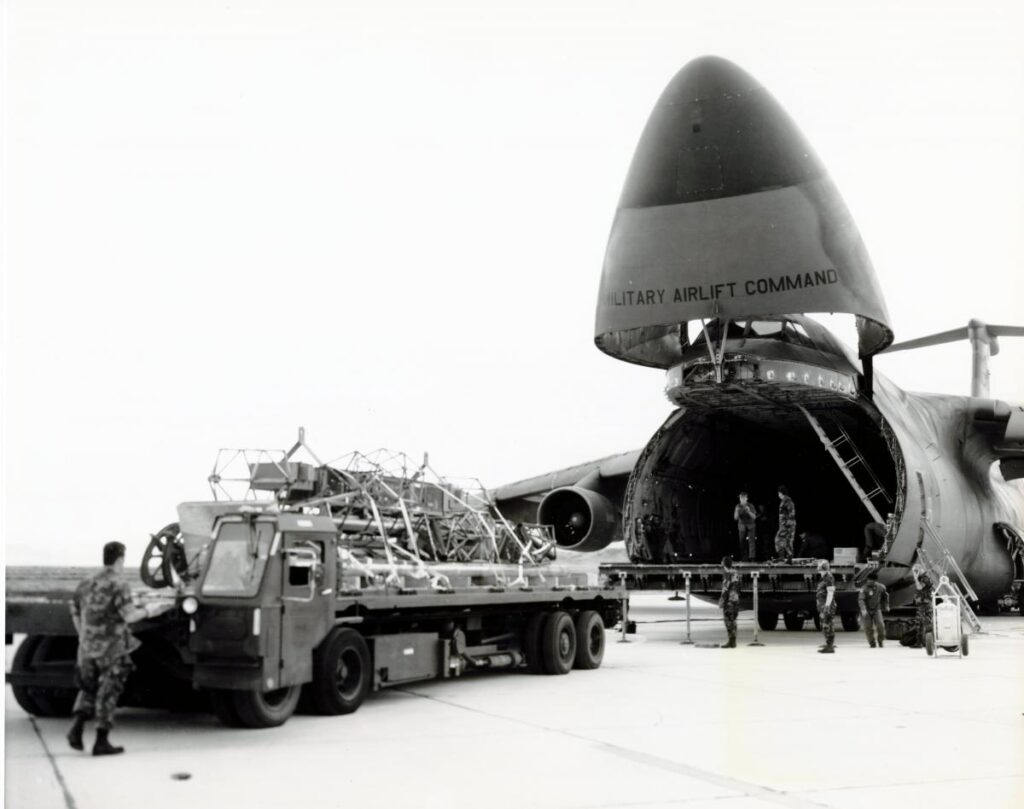
“I am certain that the main result of the Joint Verification Experiment was not the development of procedures and extent of nuclear test monitoring of the joint development of technical verification means, but the chance for interpersonal communications with the American nuclear physicists.”
Viktor N. Mikhailov, leader of the Soviet technical delegation to the JVE at the Nevada Test Site, August 17, 1988
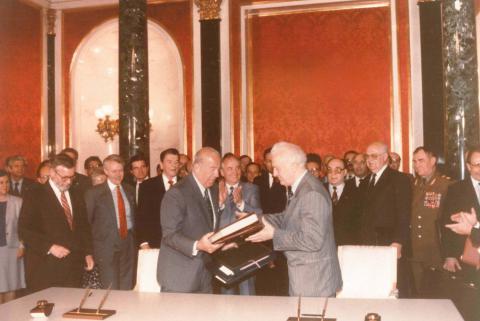
Shultz and Shevardnadze after the signing of arms control agreements in Kremlin, Moscow May 30, 1988. JVE Agreement was also signed during this meeting. Gorbachev and Reagan applaud in the background.
The Joint Verification Experiment (JVE) was a US–Soviet collaboration to measure the explosive yields of nuclear tests by each side in order to provide a verification mechanism for a treaty to limit such testing yields. This one-of-a-kind event was a product of the thaw in US–Soviet relations following the ascension of Mikhail S. Gorbachev to power in the Soviet Union in 1985. At the behest of both governments, senior specialists from U.S. and Soviet nuclear weapons laboratories came together in Geneva in 1987 to help diplomats resolve a longstanding problem that was holding up ratification of the 1974 Threshold Test Ban Treaty (TTBT). The issue was disagreement over verification procedures. In an innovative move, the two sides decided to solve the problem with a set of experiments that would allow nuclear experts to cross-evaluate the accuracy of nuclear weapon yield measurement methods. This Joint Verification Experiment (JVE) project, signed in 1988 by George Schultz and Edward Shevardnadze, envisioned conducting two nuclear test explosions, one in Nevada and one in Semipalatinsk, with yield measurements taken onsite by both sides.
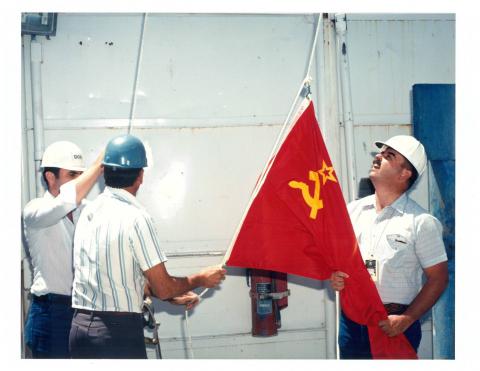
Soviet flag raised at Nevada Test Site January 1988
JVE provided the first opportunity for scientists from U.S. and Soviet nuclear weapons laboratories to meet and work cooperatively. At the Nevada Test Site and at the follow-on experiment at the Soviet Semipalatinsk Test Site they developed confidence-building steps that made possible the ratification of the TTBT in 1990. Both Russians and Americans agree that cooperation between U.S. and Soviet nuclear weapons scientists began with the JVE and the follow-on discussions on the TTBT verification mechanisms during the Geneva negotiations.
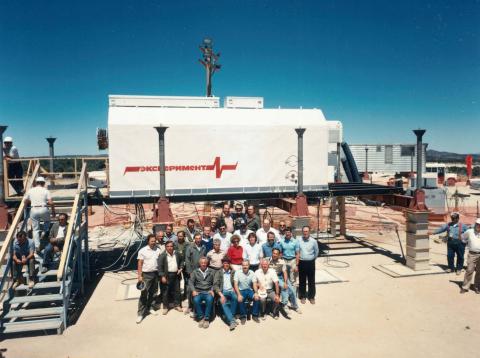
Soviet and American experiment participants in front of the Soviet trailer at NTS
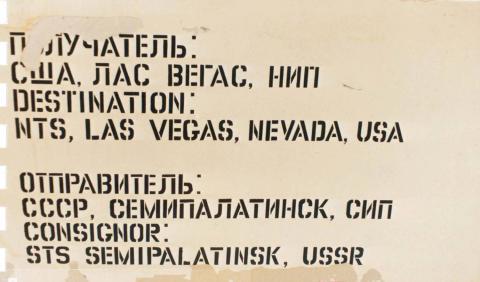
To: Nevada From: Semipalatinsk
In the Words of a Participant
For me, the Joint Verification Experiments were key to all of our future collaborations. The JVEs were unique. Both sides developed a level of trust in each other. We managed to do our work in a step-by-step process to build confidence and trust. One comment that sticks in my mind from one of the American specialists during the JVE at the Semipalatinsk Test Site in September 1988 was, “I imagined Soviet people in an absolutely different way. Now, as we become familiar with people, I can’t imagine how we could start a war with each other. Now I see they are people just like us, and they can do the same things.” I consider this to be the most important result of JVEs.
Evgeny N. Avrorin, VNIITF Scientific Director and JVE participant
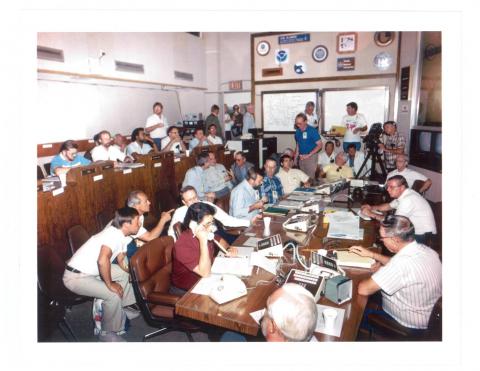
Kearsarge Test Control Room, Nevada Test Site, August 17, 1988
Find in the Book
Chapter 1 of Volume I is dedicated to the personal perspectives on JVE by Siegfried Hecker, LANL Director at that time, Ambassador C. Paul Robinson, Chief Negotiator and head of the U. S. Delegation to the U.S./USSR Nuclear Testing Talks in Geneva from 1988–90, Nikolai Pavlovich Voloshin, VNIITF, leading specialist of the Soviet team in Kearsarge Test at NTS, and Ryurik Fedorovich Trunin, one of the two representatives of VNIIEF on the Soviet Kearsarge Test team.
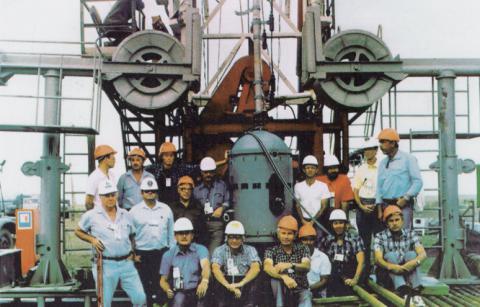
The team of USSR and U.S. specialists near the test container before its insertion into the emplacement hole. Semipalatinsk Test Site, August 1988